Lieb Lattice
This example computes the linked cluster expansion on a Lieb lattice up to order 3.
Setup
Define the three-site Lieb unit cell:
using Lincege

lieb_basis = [[0.0, 0.0], [0.0, 1.0], [1, 0]]
lieb_pvecs = [[2.0, 0.0], [0.0, 2.0]]
lieb_bonds = [Bond(1,3,[1,0],1), Bond(1,2,[0,1],2)]
lieb_uc = UnitCell(lieb_basis, lieb_pvecs, lieb_bonds, [1, 1, 1])
UnitCell([0.0 0.0 1.0; 0.0 1.0 0.0], [2.0 0.0; 0.0 2.0], [1, 1, 1], Bond[Bond(1, 3, [1, 0], 1), Bond(1, 2, [0, 1], 2)])The three-site basis contains a corner site and two edge sites. The offsets [1, 0] and [0, 1] connect to sites in neighboring cells. Bond types 1 and 2 distinguish the horizontal and vertical interactions, while equal site colors treat all sites as the same species.
Imaging the unit cell and lattice
Load Plots and ColorSchemes to activate Lincege.jl's plotting capabilities.
using Plots, ColorSchemes
image_unit_cell(lieb_uc)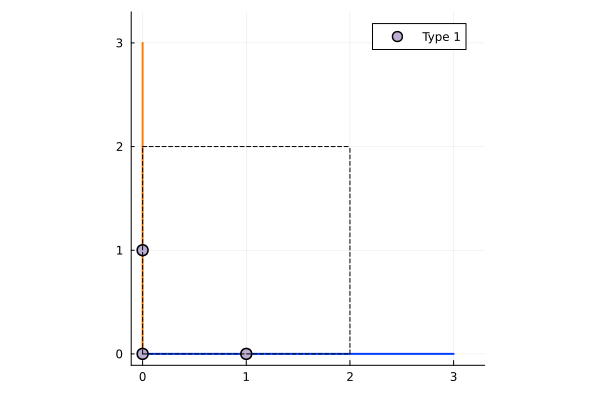
image_lattice(lieb_uc)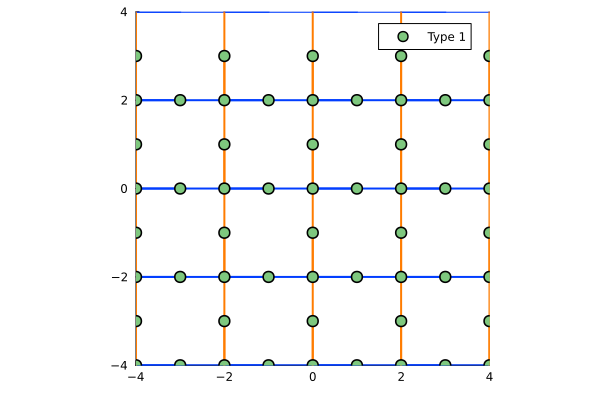
Building the lattice and clusters
The following code generates clusters up to order 3, starting with translational clusters and reducing to isomorphic clusters.
m_order = 3
lattice = SiteExpansionLattice(m_order, lieb_uc)

trans_clusters = TranslationClusterSet(lattice)
clusters_from_lattice!(trans_clusters, lattice)

iso_clusters = IsomorphicClusterSet(lattice)
reduce_clusters!(iso_clusters, trans_clusters)
ClusterSet{IsomorphicHasher} with 4 clustersComputing the expansion
The final NLCE expansion weights are computed recursively.
expansion = Expansion(iso_clusters, lattice)
summation!(expansion, m_order)
Expansion(Dict{UInt64, Lincege.ExpansionCluster}(0x68d4087bc8f29d5c => Lincege.ExpansionCluster(Vertices: [25, 81, 124], 0.3333333333333333, UInt64[0x14acd1057b698a40, 0x40656f98f1e86c11, 0x14acd1057b698a40, 0x6a7f9b876202d912, 0x14acd1057b698a40], Dict{UInt64, Float64}(0x68d4087bc8f29d5c => 1.0, 0x14acd1057b698a40 => 1.0, 0x40656f98f1e86c11 => -1.0, 0x6a7f9b876202d912 => -1.0)), 0x14acd1057b698a40 => Lincege.ExpansionCluster(Vertices: [123], 1.0, UInt64[], Dict{UInt64, Float64}(0x14acd1057b698a40 => 1.0)), 0x6a7f9b876202d912 => Lincege.ExpansionCluster(Vertices: [25, 124], 0.3333333333333333, UInt64[0x14acd1057b698a40, 0x14acd1057b698a40], Dict{UInt64, Float64}(0x6a7f9b876202d912 => 1.0, 0x14acd1057b698a40 => -2.0)), 0x40656f98f1e86c11 => Lincege.ExpansionCluster(Vertices: [25, 81], 0.3333333333333333, UInt64[0x14acd1057b698a40, 0x14acd1057b698a40], Dict{UInt64, Float64}(0x40656f98f1e86c11 => 1.0, 0x14acd1057b698a40 => -2.0))), Vector{UInt64}[[0x14acd1057b698a40], [0x6a7f9b876202d912, 0x40656f98f1e86c11], [0x68d4087bc8f29d5c]], 0)Writing to JSON
Lastly, write the results to a JSON file for future computations.
write_to_json(expansion, lattice, joinpath(output_dir, "lieb_lattice_site_expansion.json"))